Category Archives: General Care

Staple Food & Conditioning Mix

It saddens me very much that after 3 years of relentless efforts by a group of us to promote good rabbit diet through the internet, “business” seemed to ruin it for us.

Here I was walking down the aisle of the major Pet Store in Klang Valley and suddenly, my browsing pleasure was interrupted by the sales assistant who was sitting on the floor tagging prices on some rabbit food. She said, “Try this brand, it is what I use and my rabbits love it”. On closer inspection, I can only make out one word – JUNK!

This brand of rabbit food seemed to be a big hit among the local rabbit owners. And the best part is, the pellets come in 2 colors – green and orange. The green suppose to denote certain vegetable and the orange as you can guess, denotes carrots. Time and time again, we are sending very clear message to the general public that CARROTS are NOT suppose to be the staple diet of rabbits. And to top it all off, when I turn the package to the back to scrutinize the ingredients further, CORN was listed as one of the major part of the rabbit food. Corn is a major NO in a rabbit’s diet because it is extremely fattening. And usually, when ingredients like these are listed as the first few ingredients, their portions are normally above desired amount. What we need to lookout for are ingredients such as Alfalfa Meal or Timothy Hay/Meal.

Sometimes I really do not blame ignorant customers for buying these junk foodstuff for their pets. They are after all, in the mercy of what the sales assistants promote to them. And what sales assistants do best? SELL!

I told the sales assistant off, “This is junk food, good luck with your rabbits”. Well, in my heart, I wouldn’t expect more from this pet store and its chains because people at the top are ignorant too. Things will never change as long as the money rolls in continuously. Although many pet store names suggest that they care a whole lots about your pets, more often then not, they DO NOT and all they care about is money off your pockets!

As I walk further down the aisle, I was again shocked by another product that they were carrying. It was filled with seeds of all kinds and dried fruits. They are selling these as staple food. It is so disheartening to know that they can’t even separate staple food from conditioning mix.

Let me tell you what conditioning mix is. Whenever you do not see green pellets and alfalfa/timothy hay as one of the ingredients, more often than not, the product is a form of conditioning mix. Most obvious when they are made up of different seeds like sunflower seeds, black oil sunflower seeds, oats, wheat, dried banana, dried papaya and etc.

So when you see a packet of mixed seeds with little or no pellets, be positive that this is not staple food for your bunny. Besides, the real staple food for a bunny is hay. Pellets are just fillers to keep their stomach filled.

Why do we need conditioning mix? Rabbit pellets are suppose to consist all the nutrients a rabbit needs to thrive. By right, a rabbit do not need anything extra besides the pellets. True – but if you can be absolutely sure that the pellets are fresh as in they are longer than 3 months out of the mills. As time goes by, pellets like any other food stuff loses its nutritional values. Conditioning mix are usually used to make up for all nutrients that has been lost or to give some extra shine to the rabbit’s coat.

There are many types of conditioning mix used by breeders especially show breeders and they even make their own. The question is, do we need them? I believe in moderation. I have friends who feed their rabbits raisins and some other treats once in a while. Of course it is permitted and conditioning mix can be used similarly as treats.

Now I hope you know what staple food is and what conditioning mix is all about.

2 Comments

Filed under Rabbit Diet

The Terror Shaver!

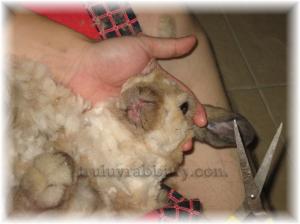
I used to help my wife groom our 2 dogs and we did buy the tools need for grooming. Till today, we still have the shaver and I thought of making good use of it. I have been putting this on hold for quite a long time. So today, I spent almost 2 hours grooming just one bunny. How did I decide who to give a shave? Well…

Thunder is having a major molt and I thought of helping him out. So I wrapped myself up and started cutting away!

On the other hand, it has proven that temperature does affect fertility in buck and by shaving him clean, I hope to experiment if it helps with fertility. I guess with a few ounces lighter, Thunder would be able to “perform” better with the does. LOL!

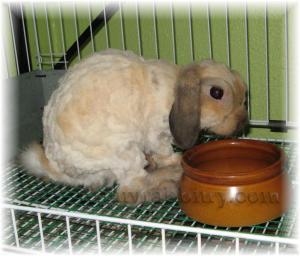
Let’s allow the photos to do all the talking. I was going for the lamb cut but somehow it didn’t turn out like how I expected.

BEFORE

BEFORE

The Slaughter Begins

The Slaughter Begins

Increase the count of "you-know-what" or be snipped!

Increase the count of "you-know-what" or be snipped!

The end product….

Lamb Cut turned out to be Lamb Chop as Susie puts it. Thunder looked like an old goat now...LOL!

Lamb Cut turned out to be Lamb Chop as Susie puts it. Thunder looked like an old goat now...LOL!

Being few ounces lighter I am sure he'll be able to perform extremely well with the does. Just like the Energize bunny!

Being few ounces lighter I am sure he'll be able to perform extremely well with the does. Just like the Energizer bunny!

I set out hoping to get Thunder looking clean shaved like this little Min Schnuazer we used to have

I set out hoping to get Thunder looking clean shaved like this little Min Schnauzer we used to have

Grooming a rabbit is harder than I thought. And the amount of fur was a much as that of 4 little dogs. Will I do it again? Absolutely! It was fun and it should be nice if I could even things out!

10 Comments

Filed under Bucks, General Care

Adventures of Un-4-tunate!

Meet Un-4-tunate, our invincible Holland Lop!

Meet Un-4-tunate, our invincible Holland Lop!

Beep! Beep!

“Mom, this new tracking device is way cool!”, said Luceel

“That’s the last toy mommy can afford. Make sure you use it well and bring it wherever you go so I can track you down easily”, his mom replied.

“I know just the right candidate to use this on”, thought Luceel

WTH!?

WTH!?

“I release you from your bondage Un-4-tunate”, said Luceel to his pet holland lop.

“Wherever you go, I’ll be able to locate you through this screen”, he thought to himself.

Beep!  Beep!  Beep! … … …

“That rascal is heading to the pet store!”, exclaimed Luceel

“Wait a minute, he stopped!”

Road Kill!

Road Kill!

The moral of the story is, NEVER let your bunny loose! They could be dead within minutes. Run over by a car and falling prey to stray animals such as cats and dogs are among the cause of death. Ensure you supervise their playtime and do not leave them unattended!

This is another community service reminder coming from TLR!

6 Comments

Filed under Adventures of Un-4-tunate, General Care, Tips For Newbies

Chopped Hay Is Junk!

Everytime I pick up the last strands of hay from the package, I realized how much loose hay and powder I have. As of late, I found that there are people repacking all these loose hay to be sold. Very enterprising. Unfortunately, loose hay does not serve much purpose for our rabbits.

Rabbits should be given strands of hay that will upkeep the motility of their guts.

So the next time you see chopped hay being sold, bear in mind that it is like someone selling their shredded paper which serve no real purpose. Stop wasting your money and time on those useless chopped hay. The only good thing I see in them is that you can fit them in the bowl.

Let’s come back to the real and actual reason we feed hay to our rabbits. It is all about stomach motility. Cellulose and fiber that helps a lot in the rabbits’ stomachs.

Have you ever seen the rabbit’s anatomy? They have very long intestines that needs long strands of grasses to help “flush” those “blockages” and poops out. Chopped hay is no different from just feeding pellets which are made of hay too.

Just get fresh hay in strands will ya?

4 Comments

Filed under Tips For Newbies

The Art Of Palpation

Practice, practice and more practice! Try feeling a pregnant doe and try feeling a non-pregnant doe. That was what I have been told to do and that was exactly what I have done.

Palpating is a very valuable skill for breeders. It helps us determine if our does are pregnant at least 10 days after mating. And since the gestation period could go a little beyond 28 days, it helps us to decide if rebreeding should be done without having to wait another 18 days more.

What can I say about my palpation experiences? I don’t have much to share since I am only beginning to learn this valuable skill. But I would like to share the most hilarious parts of the learning process.

Bearing in mind that fetuses after 10 days should feel like marbles or grapes, I put hands into practice.

There was once that I tried palpating my does and felt a PEARL NECKLACE in her! I was ecstatic! I thought I hit the jackpot. But when I palpated further, I realized that these little pearls are very close to each other. Trying to be optimistic, I just made a mental note and went to bed that night with a joyful heart. I tried again the next day and realized that my pearl necklace was gone!

As I looked into the doe’s litter tray, I realized that what I felt the day before was now in it. I was actually feeling her rectum where all the poops were. LOL!

So basically my first lesson was to differentiate between poops and kits.

I have also read about breeders mistaken the kidney for a kit. When I palpated my non pregnant does, I felt the kidney in one of them. It is very hard and rounded in shape just like how a fetus should feel like.

Wish that I could have more does to palpate in order to improve this valuable skill.

5 Comments

Filed under General Care

What Does It Really Mean Breeding The Best

We have heard it a million times. Breed closely to the standard of perfection. That is just about a very small percentage of what breeding the best is all about. Breeding closely to the SOP is just in the form of outlook as in how a rabbit should look like on the exterior. Ever wonder about the inside?

Even the famous computer manufacturer would want you to know what’s INSIDE right? That’s why you see the I*tel Inside whenever you purchase a computer. That’s because as nice as the exterior looks, your computer should have the substance to help you browse through Facebook in the speed of light. LOL!

The quality of rabbits do not depend on the type of food given or how well they are groomed or conditioned. Everything lies in GENETICS. With good genetics you get resilient, tough and very healthy rabbits. And how far are we trying to achieve this? You’ll be surprised if I say to the point where the rabbits can be champs eating junk pellets. Yes, that is exactly what good breeders are trying to do. The rabbits should be as good inside out!

There are many diseases that a bunny owner fear. We often hear about the silent killer called G.I. Stasis and others similar deadly problems in our rabbits. These are but a few problems that has not been bred out. I believe very much that well bred rabbits should be free from it should be the priority of breeders to get strong rabbits.

If you think about it, it totally make sense because if you breed something that heavily depends on let’s say a certain brand of food, what happens if the rabbit goes to a place where it is impossible to get hold of the same brand? It will certainly not thrive. Therefore, adaptability must also be a trait breeders strive for in their breeding programme.

It may sound cruel to discard the weak but if we think hard, it is totally necessary. For example, I am sure most of us like our lamb chops in certain texture. If the farm produces lambs with bad flesh, most likely it will cease to exist. And likewise, you wouldn’t be patronizing products from it as well just because you want the farm to continue its operations.

When we start off producing the best, in the long run we get to minimize out input and still maximize the output. That is what it means to breed the best. We minimie in terms of labor attending to sick animals, minimize medication and also the mortality rate. With that, our products are of quality.

With that said, there are may factors to determining quality in everything. We have been emphasizing the importance of Hay in our rabbits’ diet. It is not wise for us to go to the extreme of feeding our rabbits just hay and at the same time, it is also not wise for us to go to the extreme of feeding just pellets as well. But for now, I would like to touch on the topic of hay.

I believe we all know that hay comes in season. They are harvested in different seasons and that determines the quality of the hay as well. Same species of hay planted and harvested at different times may yield different results in terms of quality. It is said that most hay that are harvested during Autumn have the best quality.

So what actually determines the quality of hay and how do we judge as consumers. There are generally 5 determining factors namely time of harvest, the leaf & stem ratio, color of the hay, the smell of the hay and the presence of foreign objects (I once found a huge locust in my bundle of hay). Four out of five points that I have listed above could be ascertain by the consumer. It is quite difficult for us to determine the time of harvest unless we have seen how the hays from different harvest times look like.

Hay with a lot of leafs on thin or fine stems are considered as good hay harvested at good time. I am sure some of us have had the experience of getting a bag of alfalfa filled with thick stems with little leafs.

Fresh hay should be brigh green in color (though some are known to have been dyed). If your hay is light golden yellow, most probably it has been sun bleached and this reduces palatability and carotene. Still, it can be used nonetheless. Dark brown, black and brown hay should be avoided as these may be indication of rain damage or heat damage. Heat damaged hays are brown in color because of microbial (mold) growth. It means that the hay has gone moldy.

The smell of hay is another good indication of its freshness and I am sure this can be easily sensed.

And of course foreign objects can determine the quality of hay. Having poisonous plants in the packet of hay is highly undesirable while getting a locust in the hay may be an indication that it is so good that the locust can’t resist it (no scientific evidence on the latter though and the rest are sheer common sense).

Our rabbits has been domesticated for many years and to emulate their wild cousin in captivity would be something quite ridiculous. Little or more, we should believe in that there could be a slight alteration in their digestive system. And another factor to consider is that, we will never be able to stimulate the natural form of diet in captivity. Thus, we have pellets to balance things up. Pellets are of course made of hay. If you have researched on the way rabbit pellets are made, you should know that basically alfalfa is being grinded into fine powder, added to fillers and more materials to form the pellets. In feeding pellets, we can be sure that our rabbits are able to consume nutrients in a consistent manner unlike being dependant on hays which varies in quality based on the determining factors discussed earlier.

But of course, it is undeniable hay works in more ways than providing nutrients. They also act as roughage and helps in keeping our rabbits’ teeth short through the chewing process.

Coming back to the point of breeding the best, what I can say is that, the food does not and should not make the rabbits but, it matters what the rabbits make out of the food.

Lastly, I would like to share with you a story told to me by a dear friend I call Keat. It was told to him by a farmer.

Once upon a time, there was a shepherd with his flock of sheep. One of his newborn lamb is not doing well. He can hardly walk and his mama sheep rejects him. So old shepherd gave it a shot of whiskey. Sure enough, the lamb got stronger. The shepherd didn’t mind cos he now has a drinking buddy. Come time for slaughter, that weak lamb is not the biggest & the friendliest. So he survived the trip to the stockyard. Next year, all the lambs are sired by this handsome ram.

Shepherd now realized, he got nothing but a whole flock of whiskey drinking sheep. So, moral of the story….

We all have whiskey lamb for dinner! LOL…

That was my version of the moral to the story.

The real moral of the story is, the shepherd has bred weak genetics into his flock. They can’t survive without Whiskey!

And how true it is…

2 Comments

Filed under Rabbit Genetics, Random Topics

The Way I Groom It

Most of my time is spent grooming my rabbits. I groom them in a weekly basis. I just like to share with you although as simple as it is, the way I groom my rabbits.

Firstly, I groom my rabbit in all sorts of positions. Some people find it hard to groom their bellies but it is quite easy for me. I believe that top of the rabbit’s body is the easiest to reach and can be easily done.

For the bellies, I usually trance my rabbits. Likewise, I also clip their nails in that position with ease. Maybe all my bunnies are very well behaved or perhaps they are extremely comfortable with me. I prefer the latter.

Now as for the tools I use. For a rabbit in molting season, I prefer to go through him or her using the Furminator. This will get rid of tons of fur. I normally have a vacuum cleaner on as I groom so that the fur would get sucked in right away without having any going into my nose (very irritating!).

For a normal grooming session, I love using the slicker. I have 2 slicker brushes with metal bristles and one of them is a Ball Pin Slicker. I usually use the normal slicker brush on areas with thicker fur because rabbits skin is very sensitive to scratches. I have scratched a few of my bunnies accidentally and though they usually recovers fast, I get a heartache.

As for the face, paws, tail and thigh areas I use the ball pin slicker because the fur in those areas are thinner. Even with a ball pin slicker, their skin will get red if too much pressure is used while brushing.

The thing I like about using slicker brushes is that, their fur get fluff up and they end up looking like ball.

A well groomed bunny is a happy bunny. Hope this helps and happy grooming everyone!

2 Comments

Filed under General Care

Let’s Get Really Serious About This!

The weight of the Holland Lop is one of the most debated topic amongst breeders. It is also one of the most important characteristics of the Holland Lop. There is not compromise that a Holland Lop must not be heavier than 4lbs. I was also reliably informed that at the moment, most winning Holland Lops are pushing the 4lbs limit.

In order to get bulky and stocky Hollands, it is unavoidable that they pass the 4lbs mark just a tiny bit.

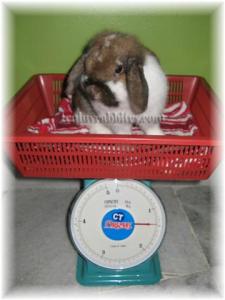
All these weight talk would be useless if one does not have a weighing machine. And today, Tru-Luv Rabbitry decided to invest on a weighing machine to ensure we adhere to the standards religiously. LOL!

I did some modifications to the weighing machine to include a basket so that the bunnies have a firm and good place to rest themselves. Guess who’s our first guinea pig? Whoops, guinea bun I mean.

Haley Baby!

Haley Baby!

8 Comments

Filed under General Care

The Undesirable 2

We all know that Holland Lops are one of the dwarf breeds. And being dwarfs, they were initially bred to have rounded skull. Just like the Netherland Dwarf, rounded skull poses a problem – Malocclusion. Which is the misalignment of the teeth. The classic example of this genetic problem is the bottom incisors outgrows over the top incisors. Breeders cull hard on this genetic trait. Sometimes this trait develops as the rabbit gets older. Malocclusion may start when the rabbit get old as well. Rabbits with Malocclusion could be extremely high in maintenance because they need regular trimming of the teeth by the vets and they must not be bred. The good news is, over the years “bigger” Holland Lops has been bred to spot the massiveness desired and their skulls are not too round anymore. This has lower the chances of getting Malocclusion greatly.

The history of Holland Lop tells us that they initially started off with solid colors and the broken was introduce by breeding them to the English Spots. While getting the broken patterns, breeders were unable to retain the rollback fur and therefore the French Angoras were used. That is the reason behind the occasional Fuzzy Holland Lops. The Fuzzy Holland Lops can be shown as American Fuzzy Lops but they can not be registered due to the reason that their pedigree will not show 3 generations of AFLs. And due to the reason that they cannot be registered with ARBA, although they can be shown as AFLs, they cannot be granded. To grand a rabbit, it has got to get 3 GC legs as we know and is registered with ARBA. This is another trait that breeders cull hard on as well.

I strongly believe that the Holland Lop is a breed that has many hidden recessive genes that certain combination of breedings may bring forth both desirable and undesirable traits. This is one of the reasons why they are a challenging breed to work with. They seemed to be like Pandora boxes opening up a whole new world with entirely new experiences for us.

Leave a comment

Filed under Rabbit Genetics

YeahooOoo Tattoo Day

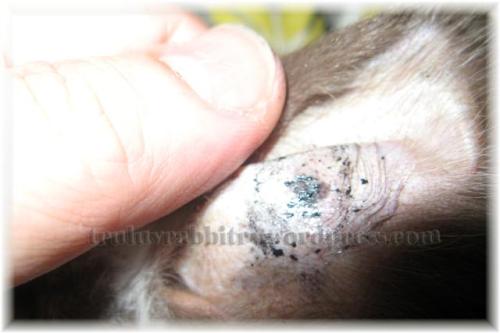
I am not a fan of tattoo on humans but I was always interested in rabbit tattoos. And since I bought myself a set of tattoo kit, I decided to put them to good use. I tattoo all 4 kits today – Truffles, Seychel, Camior and Milkyway Shiro.

It was a success and I have got many people to thank especially Susie and Teri for briefing me through what to expect. But nothing beats the real thing. I didn’t know some stuff prior to tattooing them and now I know exactly how the clamp tattoo kit works. I am not disclosing too much details as many people may not take it as something pleasant.

Anyhow, no life threatening feat and I must say that tattooing young rabbits is quite an easy task. And tattooing just one digit made it all much easier for me and also for the kits. So since I have only got 4 kits to tattoo, I went by the number from 1 to 4.

Let’s guess who’s #1, #2, #3 and #4. Please include your answers through comments based on the photos below.

img_1108

img_1109

img_1111

Can u see 2?

img_1113

img_1115

That’s an obvious 4!

8 Comments

Filed under General Care, In The Nestbox